
Chapter 13 — Testing & Benchmark Framework
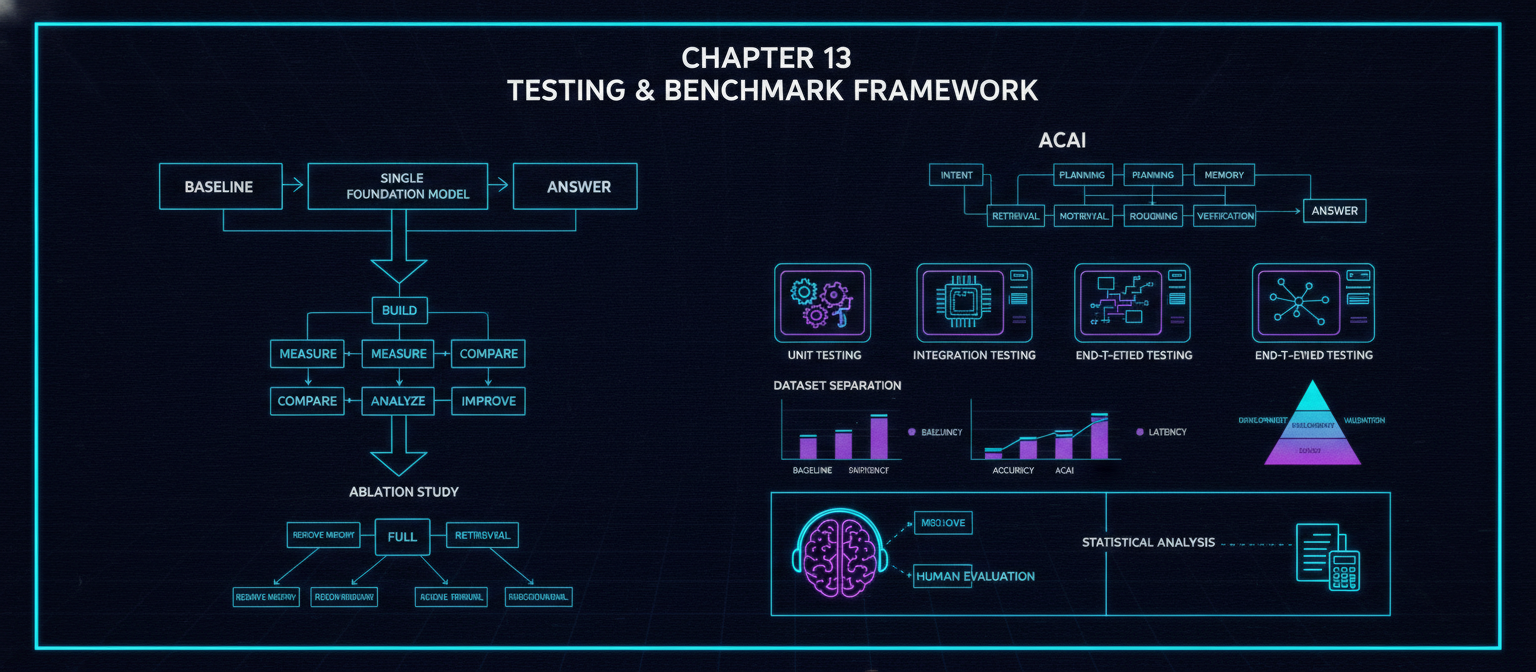
Chapter 13 — Testing & Benchmark Framework, covering the actual experimental methodology needed to determine whether ACAI performs better than a conventional single-model baseline.
Unit testing
Integration testing
End-to-end testing
Regression testing
Load testing
Security testing
Baseline vs ACAI comparison
Ablation studies
Human evaluation
13.1 Introduction
A sophisticated AI architecture cannot be considered successful merely because the software runs.
The central research question is:
Does the additional ACAI architecture measurably improve performance compared with a simpler baseline?
Chapter 13 defines a practical framework for answering that question.
The testing system should evaluate not only answer accuracy, but also retrieval quality, reasoning performance, latency, cost, reliability, and failure behavior.
The most important principle is:
Build ↓ Measure ↓ Compare ↓ Analyze ↓ Improve ↓ Measure Again 13.2 Baseline vs ACAI
The first requirement is a baseline.
Baseline User ↓ Single Foundation Model ↓ Answer ACAI User ↓ Intent ↓ Planning ↓ Memory ↓ Retrieval ↓ Model Routing ↓ Reasoning ↓ Verification ↓ Answer
The two systems should be evaluated on the same task set.
Otherwise, the comparison may not be meaningful.
13.3 Research Hypothesis
A testable hypothesis could be:
ACAI will achieve higher task-completion and answer-quality scores than the baseline on selected complex tasks, while introducing additional latency and computational overhead.
This is a hypothesis.
It should not be presented as a result until experiments demonstrate it.
13.4 Benchmark Dataset
The benchmark should represent the intended use cases.
Example categories:
General Question Answering Programming Mathematics Research Long-Context Analysis Document Understanding Planning Multilingual Tasks Structured Output Tool Use
A balanced benchmark prevents the system from appearing strong simply because it was tested on its easiest capability.
13.5 Dataset Structure
Each test case can contain:
{ "id": "task_001", "category": "programming", "prompt": "...", "expected_behavior": "...", "reference_answer": "...", "difficulty": "medium" }
Not every task requires a single reference answer.
For open-ended tasks, evaluation can instead use a rubric.
13.6 Dataset Separation
The evaluation dataset should be separated into different subsets.
Dataset │ ├── Development ├── Validation └── Test
The final test set should not repeatedly be used during development.
Otherwise, developers may unintentionally optimize the system specifically for those examples.
13.7 Unit Testing
Every individual component should have tests.
Examples:
Planner ↓ Input → Expected Plan
Retriever ↓ Query → Expected Relevant Documents
Router ↓ Task → Expected Model Class
Memory ↓ Store → Retrieve
Verifier ↓ Claim → Verification Result
Unit tests make component-level failures easier to identify.
13.8 Integration Testing
Integration testing verifies whether multiple components work together.
Example:
User Request ↓ Planner ↓ Retriever ↓ Model ↓ Verifier ↓ Response
The objective is to detect failures that do not appear when components are tested independently.
13.9 End-to-End Testing
End-to-end testing evaluates the complete application.
User ↓ Frontend ↓ API ↓ Orchestrator ↓ All Required Services ↓ Response
A complete test might verify:
Request submitted ↓ Correct plan generated ↓ Correct documents retrieved ↓ Correct model selected ↓ Response generated ↓ Verification completed ↓ Response delivered 13.10 Retrieval Benchmark
The retrieval subsystem requires independent testing.
Useful metrics include:
Precision
Of the retrieved documents, how many are relevant?
Recall
Of the relevant available documents, how many were retrieved?
Ranking Quality
Are the most useful documents appearing near the top?
Example:
Query
↓
Top 5 Results
Relevant ✓
Relevant ✓
Relevant ✓
Irrelevant ✗
Irrelevant ✗
This can be evaluated systematically using a labeled dataset.
13.11 Context Quality
Retrieval alone does not guarantee good context.
The benchmark should evaluate:
Retrieved Documents ↓ Context Builder ↓ Final Context
Questions:
Was important information preserved? Was irrelevant information removed? Were sources correctly associated? Was the context too large? Were conflicting sources identified? 13.12 Planning Benchmark
The planner can be evaluated using task decomposition.
Example:
Complex Task ↓ Expected Subtasks ↓ Generated Subtasks
Metrics can include:
Task coverage Dependency correctness Redundant-task rate Invalid-task rate Completion rate 13.13 Model Routing Benchmark
The router should be evaluated separately.
Example:
Task ↓ Router ↓ Selected Model
Then compare:
Selected Model Performance vs Best Available Model Performance
Useful metrics include:
Routing accuracy Task success Average latency Cost Fallback rate 13.14 Memory Benchmark
Memory should be tested for both retrieval and correctness.
Example:
Conversation 1 ↓ Store Memory ↓ Conversation 2 ↓ Retrieve Memory
The test should determine:
Was the correct memory retrieved? Was irrelevant memory ignored? Was outdated information handled correctly? Did memory improve task completion? 13.15 Reasoning Evaluation
Reasoning quality should be measured through the final task outcome rather than assuming that longer hidden reasoning means better reasoning.
Possible benchmark categories:
Multi-Step Mathematics Logical Problems Programming Tasks Planning Tasks Research Synthesis
The evaluation should focus on correctness and task completion.
13.16 Verification Benchmark
Create examples containing known errors.
Example:
Draft Answer ↓ Contains Known Error ↓ Verification System ↓ Should Detect Error
Possible metrics:
Detection Rate
How often are known errors detected?
False Positive Rate
How often does the verifier incorrectly reject a correct answer?
Correction Rate
How often is a detected error actually corrected?
13.17 Confidence Calibration
A confidence score is useful only if it corresponds reasonably well with actual correctness.
Example:
Confidence: 90% Actual correctness: 90%
would represent good calibration.
But:
Confidence: 95% Actual correctness: 60%
would indicate overconfidence.
Therefore, confidence should be evaluated statistically rather than simply displayed to users.
13.18 Latency Benchmark
Measure the time required for each stage.
Example:
Intent 50 ms Planning 100 ms Retrieval 250 ms Model 1,800 ms Verification 300 ms
Total 2,500 ms
This allows engineers to identify the largest bottleneck.
13.19 Cost Benchmark
For cloud-based systems, cost should be measured per request or per completed task.
Example:
Baseline Cost / Task = X
ACAI Cost / Task = Y
A more complex architecture is not automatically better if its performance improvement is too small relative to its resource cost.
13.20 Load Testing
The system should be tested under increasing concurrency.
10 Users ↓ 50 Users ↓ 100 Users ↓ 500 Users ↓ 1,000 Users
Measure:
Response latency Error rate Throughput CPU utilization GPU utilization Memory utilization Queue depth
The actual maximum capacity should come from experiments.
13.21 Stress Testing
Stress testing intentionally pushes the system beyond expected normal load.
Example:
Normal Load ↓ High Load ↓ Extreme Load ↓ Failure ↓ Recovery
The objective is to understand how the system fails and whether it recovers safely.
13.22 Failure Testing
The system should deliberately simulate failures.
Examples:
Model Offline Database Offline Vector Store Offline Network Failure Worker Crash Invalid Document Timeout Rate Limit
Expected behavior:
Failure ↓ Detection ↓ Fallback / Retry ↓ Graceful Response 13.23 Regression Testing
Every major update should run the previous benchmark suite.
Example:
Version 1.0 ↓ Benchmark ↓ Version 1.1 ↓ Same Benchmark
If a new feature improves programming but significantly damages document retrieval, the regression test should reveal it.
13.24 Ablation Study
Ablation testing is one of the most important experiments for ACAI.
Start with:
Full ACAI
Then remove components individually.
ACAI │ ├── Remove Memory ├── Remove Retrieval ├── Remove Planner ├── Remove Router └── Remove Verification
Compare the results.
This determines which components actually contribute to performance.
13.25 Example Ablation Table Configuration Accuracy Latency Cost Baseline Measure Measure Measure
Planning Measure Measure Measure
Retrieval Measure Measure Measure
Memory Measure Measure Measure
Routing Measure Measure Measure
Verification Measure Measure Measure Full ACAI Measure Measure Measure
The values must come from real experiments.
They should never be fabricated.
13.26 Human Evaluation
Some tasks cannot be evaluated completely by automated metrics.
Human reviewers can score responses using a standardized rubric.
Example:
Criterion 1 3 5 Correctness Poor Moderate Excellent Relevance Poor Moderate Excellent Clarity Poor Moderate Excellent Completeness Poor Moderate Excellent Evidence Poor Moderate Excellent
Multiple evaluators can independently score the same samples.
13.27 Blind Evaluation
When possible, reviewers should not know whether a response came from:
Baseline
or
ACAI
This reduces evaluation bias.
A practical setup:
Response A Response B
Reviewer ↓ Scores Both
The system identity can be revealed only after scoring.
13.28 Statistical Analysis
If the dataset is sufficiently large, researchers can apply statistical analysis to determine whether observed differences are likely meaningful.
Report:
Sample size Mean Median Variance Confidence intervals where appropriate Statistical tests where appropriate Effect size
A small numerical improvement should not automatically be described as a meaningful improvement.
13.29 Reproducibility
A serious research evaluation should record:
Model Version Dataset Version Prompt Version Software Version Hardware Configuration Random Seeds Evaluation Method
This allows another researcher to reproduce the experiment.
13.30 Benchmark Report
A final benchmark report should contain:
Objective
Research Question
Dataset
Baseline
ACAI Configuration
Hardware
Metrics
Experimental Procedure
Results
Ablation Study
Failure Analysis
Limitations
Conclusion 13.31 What Would Constitute Strong Evidence?
A strong result would look like:
Baseline │ ├── Accuracy ├── Latency └── Cost │ ▼ Controlled Test │ ▼ ACAI │ ├── Accuracy ├── Latency └── Cost
Then the improvement should be:
Repeated across multiple task categories Statistically or practically meaningful Reproducible Not limited to one hand-picked example Reported together with failure cases 13.32 Negative Results
Negative results are scientifically valuable.
For example:
ACAI improves:
Planning ↑ Retrieval ↑
But increases:
Latency ↑ Cost ↑
That result should still be published honestly.
It may indicate that the architecture is useful only for certain workloads.
13.33 Practical Testing Pipeline Create Dataset ↓ Define Baseline ↓ Run Baseline ↓ Run ACAI ↓ Compare ↓ Ablation Study ↓ Failure Analysis ↓ Human Evaluation ↓ Statistical Analysis ↓ Final Report 13.34 Final Benchmark Architecture TEST DATASET │ ▼ ┌────────────────┐ │ Test Controller│ └───────┬────────┘ │ ┌──────────┴──────────┐ ▼ ▼ BASELINE ACAI │ │ ▼ ▼ Responses Responses │ │ └──────────┬──────────┘ ▼ Automated Metrics │ ▼ Human Evaluation │ ▼ Statistical Analysis │ ▼ Final Results 13.35 Chapter Summary
A functioning prototype alone cannot demonstrate that ACAI is better than a conventional language-model system.
The testing framework therefore establishes a controlled methodology based on:
Baseline comparison Component-level testing Integration testing End-to-end testing Retrieval evaluation Planning evaluation Memory evaluation Verification evaluation Latency and cost measurement Load and stress testing Ablation studies Human evaluation Regression testing Reproducibility
The central rule is simple:
Do not claim improvement until the benchmark demonstrates improvement.
This turns ACAI from a collection of architectural ideas into a testable research program.
End of Chapter 13
Stay tuned for Chapter: 14 Complete End-to-End System Architecture.
🚀 Connect with Black Shadow Team Across the Web! 🌐
We are actively sharing our latest cybersecurity research, AI safety insights, ethical hacking content, and tech updates across multiple platforms. Follow and subscribe to stay updated with our official channels:
📝 Articles & Research Papers:
Medium: https://medium.com/@blackshadowteam.net
Substack: https://blackshadowteam.substack.com
Dev.to: https://dev.to/black\_shadow\_team
HackerNoon: https://hackernoon.com/u/black-shadow-team
Hashnode: https://hashnode.com/@black-shadow-team
Blogspot: https://black-shadow-team.blogspot.com/
💻 Code & Open Source:
GitHub: https://github.com/blackshadowteamnet-netizen
WordPress: https://profiles.wordpress.org/blackshadowteam
📱 Social Media & Updates:
X (Twitter): https://x.com/BlackShadoTeam
Facebook Page: https://www.facebook.com/profile.php?id=61591268330812
Facebook Profile: https://www.facebook.com/profile.php?id=100090580510673
Instagram: https://www.instagram.com/black\_shadow\_team\_x/
Threads: https://www.threads.net/@blacky\_mahin\_x
Bluesky: https://bsky.app/profile/black-shadow-team.bsky.social
💬 Community & Discussions:
Reddit: https://www.reddit.com/user/blackshadowteamoffic/
Quora (Bangla): https://bn.quora.com/profile/Black-Shadow-Team
Mix: https://mix.com/black\_shadow\_team
Discord: https://discord.com/channels/1518981404074184725/1518981404632023143
🎵 Short Videos & Audio:
TikTok: https://www.tiktok.com/@blackshadowteam.net
SoundCloud: https://on.soundcloud.com/VBWtOYsgktkw37kAza
Goodreads: https://www.goodreads.com/user/show/203582586-black-shadow-team-team
Stay connected and join our growing cybersecurity community! 🛡️✨