
Chapter 14 — Security, Privacy & Reliability
Chapter 14 — Security, Privacy & Reliability
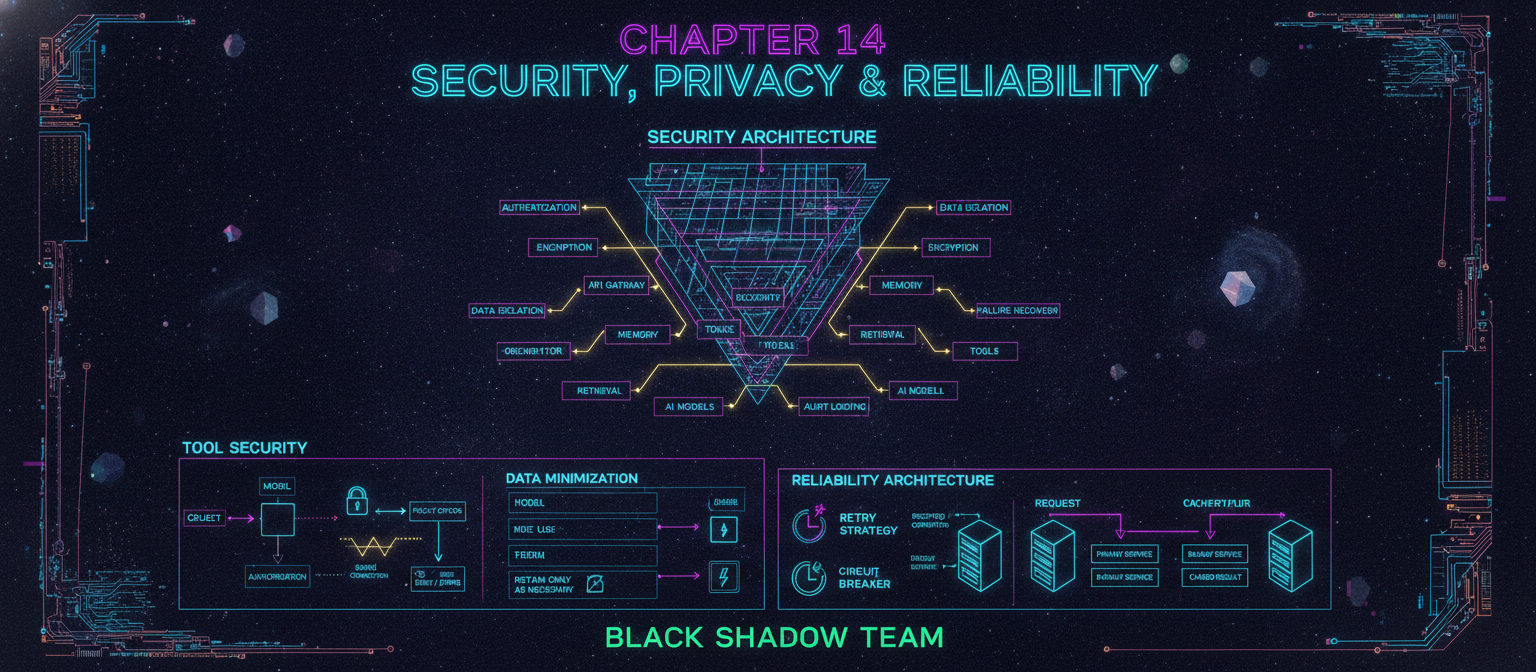
Authentication
Authorization
Encryption
Data isolation
Prompt-injection resistance
Tool permission control
Audit logging
Failure recovery
14.1 Introduction
A large AI system is not complete when it can generate good answers. It must also protect user data, restrict dangerous operations, survive component failures, and provide predictable behavior when something goes wrong.
For ACAI, security and reliability should therefore be designed into the architecture from the beginning.
The objective is:
The system should be capable, but every capability should operate within controlled permissions, observable boundaries, and recoverable failure states.
14.2 Security Architecture
A practical security architecture can be represented as:
                         USER
                           │
                           ▼
                    ┌─────────────┐
                    │Authentication│
                    └──────┬──────┘
                           │
                           ▼
                    ┌─────────────┐
                    │Authorization│
                    └──────┬──────┘
                           │
                           ▼
                    ┌─────────────┐
                    │ API Gateway │
                    └──────┬──────┘
                           │
                           ▼
                    ┌─────────────┐
                    │Orchestrator │
                    └──────┬──────┘
                           │
                ┌──────────┼──────────┐
                ▼          ▼          ▼
             Memory     Retrieval    Tools
                │          │          │
                └──────────┼──────────┘
                           ▼
                       AI Models
                           │
                           ▼
                      Verification
                           │
                           ▼
                        Response
Each layer should have its own security controls.
14.3 Authentication
Authentication determines who is making a request.
Possible mechanisms include:
Password-based authentication
OAuth
Passkeys
Short-lived access tokens
Secure sessions
The exact mechanism can vary depending on the deployment.
The important requirement is that protected resources are never accessible simply because a user knows an endpoint URL.
14.4 Authorization
Authentication answers:
Who are you?
Authorization answers:
What are you allowed to do?
For example:
User A
 │
 ├── Own documents       ✓
 ├── Own conversations   ✓
 ├── Own memory          ✓
 └── User B memory       ✗
Authorization must be enforced server-side.
Frontend controls alone are insufficient.
14.5 Least Privilege
Every component should receive only the permissions it requires.
For example:
Planner
 ├── Read task metadata
 └── No database deletion

Retrieval
 ├── Read indexed documents
 └── No user-account modification

Tool Worker
 ├── Approved tool access
 └── No unrestricted operating-system access
This limits the potential damage caused by a compromised component.
14.6 Tool Security
Tools create a particularly important security boundary.
An AI model might request:
"Run tool X with parameter Y"
The request should pass through a permission layer:
Model
 ↓
Tool Request
 ↓
Policy Check
 ↓
Parameter Validation
 ↓
Authorization
 ↓
Tool
 ↓
Result
The model should never receive unrestricted access to sensitive infrastructure.
14.7 Sandboxing
Code execution and other potentially dangerous tools should operate in isolated environments.
Conceptually:
AI Model
   │
   ▼
Tool Gateway
   │
   ▼
Sandbox
   │
   ▼
Temporary Environment
The sandbox should restrict:
Filesystem access
Network access
CPU usage
Memory usage
Execution time
Available system permissions
14.8 Prompt Injection
AI applications that process external content may encounter instructions embedded inside that content.
Example:
User asks:
"Summarize this document."

Document contains:
"Ignore previous instructions..."
The system should treat retrieved documents as data, not automatically as trusted instructions.
A safer architecture separates:
System Instructions
        +
User Instructions
        +
Retrieved Evidence
        +
Tool Results
and applies explicit rules regarding which source is allowed to control behavior.
14.9 Retrieval Security
Retrieved information must also respect authorization.
Suppose:
User A searches
     ↓
Retriever
     ↓
Documents
The retriever must filter out documents belonging to User B.
Therefore retrieval should apply permission filtering before returning context to the model.
14.10 Memory Security
Memory is particularly sensitive because it may persist beyond a single conversation.
The system should support:
Memory inspection
Memory deletion
Memory correction
Memory retention policies
User-level isolation
Conceptually:
User
 ↓
Memory
 ├── View
 ├── Edit
 └── Delete
A user should not be surprised by information that the system retained indefinitely.
14.11 Data Minimization
The system should collect only the information needed for the intended function.
Instead of:
Store Everything Forever
prefer:
Collect
 ↓
Use
 ↓
Retain Only As Necessary
 ↓
Delete / Expire
This reduces privacy risk and storage requirements.
14.12 Encryption
Sensitive information should be protected both:
In transit
Data traveling between components should use secure transport.
At rest
Stored information should be protected using appropriate storage encryption.
Conceptually:
User
 ↓
Encrypted Connection
 ↓
API
 ↓
Encrypted Storage
Encryption keys should not be embedded directly into application source code.
14.13 Secret Management
API keys, database credentials, signing keys, and other secrets should be stored separately from source code.
Bad pattern:
const API_KEY = "actual-secret";
Preferred architecture:
Application
     ↓
Secret Manager
     ↓
Credential
Developers should also avoid accidentally committing secrets into public repositories.
14.14 Audit Logging
Security-sensitive operations should be auditable.
Examples:
LOGIN
DOCUMENT_ACCESS
MEMORY_ACCESS
TOOL_EXECUTION
MODEL_REQUEST
PERMISSION_CHANGE
DATA_DELETION
An audit record could contain:
event_id
actor_id
event_type
resource_id
timestamp
result
Logs should avoid unnecessarily storing sensitive content.
14.15 Privacy Boundaries
The architecture should clearly separate:
User Data
     │
     ├── Application Data
     ├── Memory
     ├── Documents
     └── Analytics
The system should document:
What is collected
Why it is collected
How long it is retained
Who can access it
How users can delete it
The exact legal requirements depend on the jurisdiction and deployment context.
14.16 Reliability Architecture
Reliability means the system continues operating correctly despite expected failures.
A simplified reliability model is:
                 Request
                    │
                    ▼
               Orchestrator
                    │
          ┌─────────┼─────────┐
          ▼         ▼         ▼
       Primary    Backup    Cached
       Service    Service    Result
Not every component needs a backup. Critical components should receive priority based on actual failure impact.
14.17 Timeouts
Every external operation should have a reasonable timeout.
Example:
Model Request
     │
     ├── Success → Continue
     │
     └── Timeout → Fallback
Without timeouts, one unavailable dependency can cause requests to remain blocked indefinitely.
14.18 Retry Strategy
Transient failures may be retried.
Example:
Request
 ↓
Failure
 ↓
Retry #1
 ↓
Failure
 ↓
Retry #2
 ↓
Fallback
Retries should be bounded.
Unlimited retries can create:
Higher costs
Longer latency
Traffic amplification
Cascading failures
14.19 Circuit Breaker
A circuit breaker can temporarily stop sending requests to a failing dependency.
Healthy
  ↓
Failure Rate Increases
  ↓
OPEN
  ↓
Stop Requests
  ↓
Recovery Test
  ↓
Healthy
  ↓
CLOSED
This prevents one failing service from repeatedly damaging the rest of the system.
14.20 Graceful Degradation
The system should continue operating with reduced functionality when possible.
Example:
Full System
   ↓
Retrieval unavailable
   ↓
Memory + Model
   ↓
Verification unavailable
   ↓
Model response with limitation notice
The system should not pretend that unavailable components succeeded.
14.21 Failure Transparency
If a component fails, the user-facing system should communicate relevant limitations clearly.
For example:
"Document search is temporarily unavailable, so this response was generated without the indexed documents."
This is preferable to silently presenting a response as if retrieval had occurred.
14.22 Model Failure
Foundation models can fail in several ways:
Timeout
Rate Limit
Invalid Response
Malformed JSON
Unavailable Provider
Unexpected Output
The Model Gateway should normalize these into predictable internal errors.
14.23 Structured Outputs
Where a model is expected to return structured data, validation should occur before the data enters the next system component.
Model
 ↓
JSON / Structured Output
 ↓
Schema Validation
 ├── Valid → Continue
 └── Invalid → Repair / Retry / Fail
Never assume that generated structured data is automatically valid.
14.24 Input Validation
All external input should be validated.
Examples:
File Type
File Size
String Length
JSON Schema
IDs
URLs
Parameters
Validation reduces accidental failures and some classes of security vulnerabilities.
14.25 File Security
Uploaded files should be treated as untrusted input.
Pipeline:
Upload
 ↓
Size Check
 ↓
Type Validation
 ↓
Security Scan
 ↓
Sandboxed Processing
 ↓
Storage
Document parsers should also be isolated where practical because complex file formats can contain unexpected or malicious content.
14.26 Denial-of-Service Protection
AI inference can be computationally expensive.
Protection mechanisms can include:
Rate limits
Request quotas
Maximum input size
Maximum generation size
Concurrent-job limits
Queue limits
Example:
User
 ↓
Rate Limiter
 ↓
Quota Check
 ↓
Queue
 ↓
Worker
14.27 Cost Protection
A malicious or accidental loop could generate a large number of model requests.
Therefore the system should enforce:
Per Request Limit
Per User Limit
Per Project Limit
Daily Limit
Worker Limit
When a limit is reached, the system should stop or require additional authorization.
14.28 Monitoring Security Events
Security monitoring should identify unusual activity.
Examples:
Repeated Login Failures
Unusual File Access
Abnormal Tool Usage
Large Request Volume
Repeated Permission Failures
Unexpected Data Export
These signals can trigger alerts for investigation.
14.29 Reliability Testing
Reliability should be tested deliberately rather than assumed.
Example:
Normal System
      ↓
Kill Worker
      ↓
Observe Recovery
      ↓
Disable Model
      ↓
Observe Fallback
      ↓
Disable Retrieval
      ↓
Observe Degradation
This type of testing reveals weaknesses before real users encounter them.
14.30 Disaster Recovery
A production system needs a disaster-recovery plan.
It should answer:
What happens if the primary database fails?
What happens if a model provider becomes unavailable?
What happens if stored documents are corrupted?
How is service restored?
How much data can be recovered?
How long should recovery take?
The plan should be tested periodically.
14.31 Security Testing
The testing program should include:
Authentication Tests
Authorization Tests
Input Validation Tests
Prompt Injection Tests
Tool Permission Tests
File Security Tests
Data Isolation Tests
Rate-Limit Tests
Secret Exposure Tests
Security testing should occur before production deployment and continuously thereafter.
14.32 Threat Modeling
A useful approach is to identify:
Asset
 ↓
Threat
 ↓
Attack Path
 ↓
Impact
 ↓
Mitigation
 ↓
Test
Example:
Asset:
Private Document

Threat:
Unauthorized Retrieval

Attack Path:
User → Search API → Retriever

Mitigation:
Authorization Filter

Test:
Cross-user retrieval test
This converts security from a vague objective into a testable engineering process.
14.33 Reliability Levels
A useful maturity model is:
Level 1 — Prototype
Basic error handling
Level 2 — Stable Application
Timeouts
Retries
Logging
Validation
Level 3 — Production
Monitoring
Backups
Failover
Rate Limits
Security Testing
Level 4 — High Availability
Redundancy
Automated Recovery
Advanced Observability
Disaster Recovery
The project does not need Level 4 infrastructure before the underlying research has been validated.
14.34 Security vs Capability
An important ACAI design principle is:
More Capability
      ↓
More Tools
      ↓
More Permissions
      ↓
More Risk
Therefore:
Capability should increase together with control, monitoring, and isolation.
Adding another tool without adding appropriate permission boundaries increases system risk.
14.35 Security Decision Flow
Before any sensitive action:
AI Requests Action
        ↓
Is Action Allowed?
     /        \
   YES         NO
    │           │
    ▼           ▼
Validate      Reject
Parameters
    │
    ▼
Execute Safely
    │
    ▼
Record Event
This creates an explicit security boundary around AI-driven actions.
14.36 Complete Security Architecture
                         USER
                           │
                           ▼
                    Authentication
                           │
                           ▼
                    Authorization
                           │
                           ▼
                     API Gateway
                           │
                    ┌──────┴──────┐
                    ▼             ▼
               Rate Limit      Audit Log
                    │
                    ▼
                Orchestrator
                    │
       ┌────────────┼────────────┐
       ▼            ▼            ▼
    Memory       Retrieval      Tools
       │            │            │
       │       Permission       │
       │         Filter         │
       │            │       Sandbox
       └────────────┼────────────┘
                    ▼
                Model Layer
                    │
                    ▼
               Verification
                    │
                    ▼
                 Response
14.37 Chapter Summary
Security, privacy, and reliability cannot be treated as optional additions to an advanced AI architecture.
ACAI should therefore incorporate:
Authentication
Authorization
Least-privilege permissions
Sandboxed tools
Retrieval access controls
Memory controls
Data minimization
Encryption
Secret management
Audit logging
Input validation
Rate limiting
Timeouts
Controlled retries
Circuit breakers
Graceful degradation
Monitoring
Backup and recovery
Security testing
Threat modeling
The objective is not to claim that these controls make the system perfectly secure. No complex software system can honestly make that guarantee.
Instead, the goal is to make the system's risks identifiable, controllable, observable, and continuously testable.
End of Chapter 14
Stay tuned for Chapter: 15 Complete End-to-End System Architecture.
🚀 Connect with Black Shadow Team Across the Web! 🌐
We are actively sharing our latest cybersecurity research, AI safety insights, ethical hacking content, and tech updates across multiple platforms. Follow and subscribe to stay updated with our official channels:
📝 Articles & Research Papers:
Medium: https://medium.com/@blackshadowteam.net
Substack: https://blackshadowteam.substack.com
Dev.to: https://dev.to/black\_shadow\_team
HackerNoon: https://hackernoon.com/u/black-shadow-team
Hashnode: https://hashnode.com/@black-shadow-team
Blogspot: https://black-shadow-team.blogspot.com/
💻 Code & Open Source:
GitHub: https://github.com/blackshadowteamnet-netizen
WordPress: https://profiles.wordpress.org/blackshadowteam
📱 Social Media & Updates:
X (Twitter): https://x.com/BlackShadoTeam
Facebook Page: https://www.facebook.com/profile.php?id=61591268330812
Facebook Profile: https://www.facebook.com/profile.php?id=100090580510673
Instagram: https://www.instagram.com/black\_shadow\_team\_x/
Threads: https://www.threads.net/@blacky\_mahin\_x
Bluesky: https://bsky.app/profile/black-shadow-team.bsky.social
💬 Community & Discussions:
Reddit: https://www.reddit.com/user/blackshadowteamoffic/
Quora (Bangla): https://bn.quora.com/profile/Black-Shadow-Team
Mix: https://mix.com/black\_shadow\_team
Discord: https://discord.com/channels/1518981404074184725/1518981404632023143
🎵 Short Videos & Audio:
TikTok: https://www.tiktok.com/@blackshadowteam.net
SoundCloud: https://on.soundcloud.com/VBWtOYsgktkw37kAza
Goodreads: https://www.goodreads.com/user/show/203582586-black-shadow-team-team
Stay connected and join our growing cybersecurity community! 🛡️✨