
Chapter 64 — Secure AI Database & Data Access Layer
64.1 Introduction
An AI platform ultimately depends on its data layer.
The database may contain:
user accounts
tenant information
AI conversations
workflow state
generation history
document metadata
model configurations
billing records
permissions
audit references
embeddings
application settings
security events
Therefore, compromising the database can potentially compromise the entire application.
A secure database architecture should follow one fundamental principle:
Database access must be explicitly authorized, minimally privileged, tenant-aware, encrypted, observable, and resilient against accidental or malicious misuse.
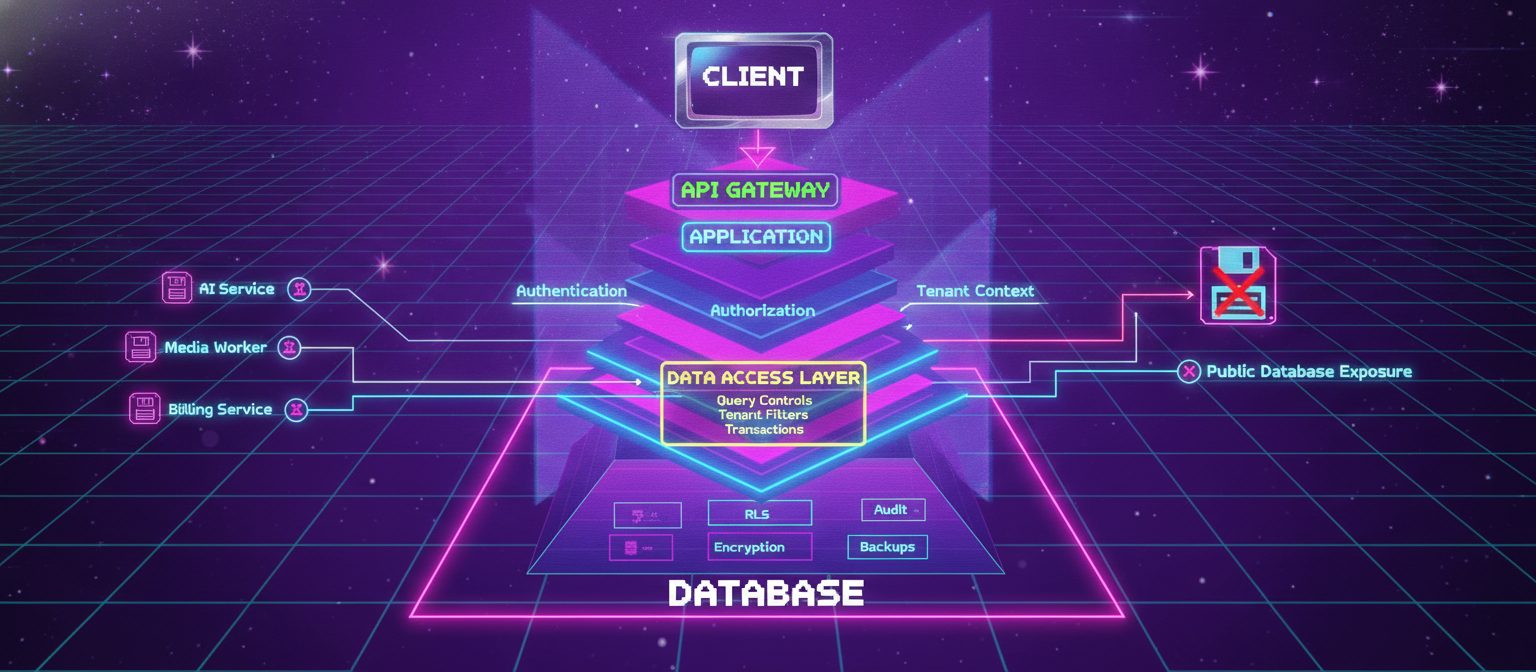
64.2 Database Security Architecture
A typical architecture is:
Client
   │
   ▼
API Gateway
   │
   ▼
Application Service
   │
   ▼
Authorization / Policy
   │
   ▼
Data Access Layer
   │
   ▼
Database
The browser should generally not connect directly to the primary application database.
Instead:
Browser
   ↓
API
   ↓
Application
   ↓
Database
This gives the application control over:
authentication
authorization
validation
tenant isolation
business rules
auditing
rate limiting
64.3 Database Trust Boundary
The database should be treated as a protected security boundary.
A useful separation is:
Public Zone
     │
     ▼
API Zone
     │
     ▼
Application Zone
     │
     ▼
Data Zone
The database should generally be reachable only by authorized application or data-processing workloads.
Public internet traffic should not directly reach the database.
64.4 Least-Privilege Database Accounts
Do not use one unrestricted database account for every service.
Instead:
AI Service
   ↓
AI database role

Media Worker
   ↓
Media database role

Billing Service
   ↓
Billing database role
Each role receives only the required permissions.
For example:
media_worker:
  SELECT media_records
  INSERT media_results

DENY:
  billing_records
  user_credentials
  security_admin
This reduces blast radius if a service is compromised.
64.5 Separate Read and Write Permissions
Where practical, separate database privileges.
Example:
read_service
   → SELECT

write_service
   → SELECT
   → INSERT
   → UPDATE
Destructive operations should require stronger authorization.
For example:
DELETE
DROP
ALTER
TRUNCATE
should not be available to ordinary application identities.
64.6 Application Authorization vs Database Authorization
Application authorization remains essential.
For example:
User A
   ↓
API
   ↓
Authorization
   ↓
Database
However, database-level controls can provide an additional defense layer.
A strong architecture does not depend on a single authorization check.
Instead:
Identity
   ↓
Application policy
   ↓
Database policy
   ↓
Resource ownership
64.7 Multi-Tenant Database Security
A SaaS AI platform may contain:
Tenant A
Tenant B
Tenant C
The database must prevent accidental cross-tenant access.
Every tenant-owned record should have an appropriate ownership boundary.
For example:
generations
------------
id
tenant_id
user_id
prompt
status
created_at
A query should be conceptually:
WHERE id = requested_id
AND tenant_id = authorized_tenant
rather than simply:
WHERE id = requested_id
64.8 Tenant Context
The application should establish tenant context before accessing tenant data.
Example:
Authenticated user
        ↓
Determine tenant
        ↓
Validate membership
        ↓
Create request context
        ↓
Data access
The tenant should not simply be accepted from an arbitrary client parameter.
Unsafe concept:
GET /data?tenant_id=other_tenant
The server must independently determine whether the caller is allowed to access that tenant.
64.9 Row-Level Security
Some database systems support Row-Level Security (RLS).
Conceptually:
Table
 │
 ├── Tenant A rows
 ├── Tenant B rows
 └── Tenant C rows
A database policy can restrict which rows a database role may access.
This creates another isolation layer.
However, RLS should be carefully designed and tested. Incorrect policies can either expose data or unintentionally block legitimate operations.
64.10 Defense in Depth for Tenant Isolation
A strong tenant architecture can use multiple controls:
API authorization
       ↓
Tenant membership
       ↓
Service authorization
       ↓
Query tenant constraint
       ↓
Database RLS
       ↓
Storage tenant boundary
The objective is that one implementation mistake does not automatically expose another tenant's data.
64.11 ORM Security
An ORM such as Prisma can simplify application/database interaction.
The ORM should be treated as a convenience layer, not as a security boundary.
Security must still include:
authorization
tenant filtering
validation
safe query construction
transaction controls
privilege management
A correct ORM query does not automatically mean the user is authorized to run it.
64.12 SQL Injection
Modern ORMs and parameterized queries greatly reduce classic SQL injection risks.
Unsafe conceptual pattern:
"SELECT * FROM users WHERE name = '" + input + "'"
Safer:
Parameterized query
The key principle is:
Treat user-controlled values as data, never as executable query syntax.
This applies even when using an ORM.
64.13 Dynamic Queries
Some applications need dynamic:
sorting
filtering
column selection
reporting
search
These require additional care.
User input should not directly become arbitrary SQL identifiers.
Instead, use an allowlist:
Allowed sort fields:
created_at
name
status
Reject:
unknown_column
arbitrary_expression
64.14 Database Transactions
Transactions help preserve consistency across related changes.
Example:
Create generation
+
Create usage record
+
Reserve quota
These operations may need to succeed together.
Conceptually:
BEGIN
   create generation
   reserve quota
   create usage record
COMMIT
If a critical operation fails:
ROLLBACK
The exact transaction boundary should reflect the application's consistency requirements.
64.15 Transaction Security
Transactions should not be unnecessarily long.
Long-running transactions can cause:
lock contention
resource consumption
latency
deadlocks
AI inference should generally not be held inside a database transaction merely because the overall workflow involves AI.
Prefer:
Database transaction
   ↓
commit state
   ↓
AI operation
   ↓
database transaction
   ↓
save result
rather than keeping a database transaction open during a potentially long model call.
64.16 Optimistic Concurrency
AI workflows often update shared state.
Example:
Workflow version = 8
Worker A reads version 8.
Worker B updates it to version 9.
Worker A attempts to save using version 8.
The database rejects the stale update.
This prevents older workers from silently overwriting newer state.
64.17 Database Connection Security
Database connections should use:
encryption in transit
authentication
strong credentials or workload identity where supported
connection limits
appropriate timeouts
controlled network access
Database credentials should not be embedded in source code.
64.18 Connection Pooling
AI applications may generate large numbers of requests.
Opening a new database connection for every request can create unnecessary overhead.
Connection pooling allows controlled reuse.
But the pool itself needs limits:
maximum connections
minimum connections
idle timeout
connection timeout
request timeout
Without limits, traffic spikes can exhaust database resources.
64.19 Connection Exhaustion
Suppose:
1000 requests
arrive simultaneously.
If every request creates an unrestricted database connection:
1000 requests
   ↓
1000 DB connections
   ↓
Database overload
A bounded connection pool provides backpressure.
1000 requests
   ↓
bounded pool
   ↓
controlled concurrency
64.20 Query Timeout
Queries should not run indefinitely.
Long-running queries may consume:
CPU
memory
connections
locks
The system should use appropriate query and request timeouts.
Particularly expensive analytics should be isolated from latency-sensitive transactional queries.
64.21 Database Resource Quotas
Where supported, control:
connections
storage
query duration
CPU
memory
I/O
At the application level, also consider:
queries/request
records/request
pagination size
export size
This reduces resource-exhaustion risk.
64.22 Pagination
APIs should avoid returning unlimited database results.
Unsafe conceptual request:
GET /generations?all=true
Safer:
GET /generations?page=1&limit=50
The server should enforce a maximum limit.
For example:
requested limit = 1,000,000
server maximum = 100
The server should use the maximum rather than trusting the client.
64.23 Search Security
AI platforms frequently implement search across:
conversations
documents
media
projects
knowledge bases
Search must preserve authorization.
Bad architecture:
Search
 ↓
All documents
 ↓
Filter later
Safer:
Authorized scope
 ↓
Search within authorized dataset
Authorization should be part of the data retrieval design.
64.24 RAG Database Security
A vector database or vector-enabled relational database may contain embeddings associated with private content.
Therefore, embeddings should inherit the access controls of their source documents.
Example:
Document
   ↓
Tenant A
   ↓
Embedding
   ↓
Tenant A retrieval scope
A user must not receive a vector result merely because it is semantically relevant.
The user must also be authorized to access the underlying content.
64.25 Vector Search Isolation
A secure retrieval query may need filters such as:
tenant_id
workspace_id
project_id
document_id
classification
access_scope
Conceptually:
semantic similarity
+
authorization filter
rather than semantic similarity alone.
64.26 Database Encryption at Rest
Sensitive databases should use encryption at rest where supported.
This helps protect stored data if physical storage media or snapshots are improperly accessed.
Encryption at rest does not replace:
authorization
network security
application security
access logging
It is one layer of defense.
64.27 Encryption Key Management
Encryption keys should be managed separately from ordinary application data.
Avoid storing:
database
  └── encryption_key
in the same uncontrolled location as the encrypted data.
Use an appropriate key-management system.
Key access should be:
restricted
audited
rotated according to policy
separated by environment
64.28 Field-Level Protection
Some particularly sensitive fields may require additional protection.
Examples can include:
private configuration
sensitive profile attributes
recovery information
high-value application secrets
Depending on requirements, these can use application-level encryption or tokenization.
The system should distinguish between:
encrypted field
hashed value
tokenized value
plaintext
because these mechanisms have different properties.
64.29 Password Storage
Passwords should never be stored as plaintext.
A password verifier should use a password hashing algorithm designed for password storage, with appropriate parameters and salts.
The application should never need to recover a user's original password.
64.30 Secrets vs User Data
A database may contain ordinary application data and secrets.
These should not automatically share the same storage model.
Prefer dedicated secret-management infrastructure for:
API credentials
provider keys
database credentials
signing keys
encryption keys
service credentials
Application data belongs in the database; secrets should generally live in a purpose-built secret-management system.
64.31 Database Audit Logging
Important database actions should be observable.
Examples:
privilege changes
schema changes
sensitive data access
administrative queries
failed authentication
unusual exports
deletion operations
Logs should be protected against unauthorized modification.
64.32 Data Access Audit Trail
For especially sensitive resources, application-level auditing can record:
who
accessed what
when
from which service
for what operation
result
Example:
user_123
READ
document_456
tenant_789
2026-09-06T...
success
The exact level of logging should balance security, privacy, cost, and operational needs.
64.33 Database Backups
A database security strategy is incomplete without backup security.
Backups should be:
encrypted
access-controlled
monitored
retained according to policy
tested through restoration
A backup that cannot be restored is not a reliable backup.
64.34 Backup Isolation
Backups should not depend entirely on the same credentials and infrastructure as the production database.
Otherwise:
Production compromise
       ↓
Backup compromise
can occur.
Separate administrative boundaries and protected backup systems can reduce this risk.
64.35 Restore Testing
Regular restore tests should verify:
backup exists
backup is readable
keys are available
schema is compatible
data can be restored
application can reconnect
recovery procedures work
The recovery process should be documented rather than relying on one engineer's memory.
64.36 Point-in-Time Recovery
Where supported, point-in-time recovery can reduce data loss.
For example:
09:00 healthy
09:15 accidental deletion
09:30 discovered
The system may be able to restore to an earlier valid state.
This is especially useful for operational mistakes and certain incident scenarios.
64.37 Soft Delete vs Hard Delete
Some resources may benefit from soft deletion.
Example:
deleted_at = timestamp
instead of immediately destroying the record.
This can help with:
recovery
auditing
accidental deletion
However, soft deletion does not satisfy every privacy or deletion requirement.
If a policy requires actual deletion, retained copies and backups must also be considered.
64.38 Data Retention
Database records should have defined retention policies.
Example:
temporary job data
→ short retention

audit records
→ policy-defined retention

user content
→ user-controlled retention where appropriate

system metrics
→ operational retention
Retention should be intentional rather than unlimited.
64.39 Secure Data Deletion
Deletion should consider all copies:
Primary DB
   ↓
Read replicas
   ↓
Cache
   ↓
Search index
   ↓
Vector database
   ↓
Object storage
   ↓
Backups
A delete button in the UI does not necessarily mean the data has disappeared everywhere.
The application should define what “deleted” means operationally and legally.
64.40 Database Cache Consistency
AI systems may cache database results.
For example:
Database
   ↓
Cache
   ↓
API
If access permissions change, stale cache entries can become a security risk.
Therefore, cached sensitive data should have:
expiration
appropriate invalidation
tenant-aware keys
authorization-aware access
64.41 Tenant-Aware Cache Keys
Avoid:
cache:user:123
when resource identity alone could collide across security contexts.
Where appropriate, use a security-aware namespace:
cache:tenant:456:user:123
The exact key structure depends on the application's identity model.
64.42 Database Export Security
Export functionality can create significant data-exfiltration risk.
Examples:
CSV export
JSON export
backup download
analytics report
bulk API
Exports should have:
authorization
size limits
rate limits
audit logging
appropriate expiration
secure delivery
64.43 Bulk Export Controls
A user who can read one document does not necessarily need permission to export:
500,000 documents
Bulk access can require an additional permission.
Example:
document:read
does not automatically imply:
document:bulk_export
64.44 Administrative Database Access
Production database administration should be tightly controlled.
Prefer:
named administrator
+
strong authentication
+
temporary elevation
+
audit logging
rather than:
shared admin password
Administrative access should be exceptional rather than routine.
64.45 Production Schema Changes
Schema migrations can affect production availability and data integrity.
A controlled process should include:
development
 ↓
testing
 ↓
migration review
 ↓
backup/recovery verification
 ↓
staged deployment
 ↓
monitoring
Dangerous destructive migrations should receive additional review.
64.46 Migration Security
Migration files should be:
version controlled
reviewed
tested
attributable to a deployment
reproducible
Avoid manually changing production schema without recording the change.
Otherwise, development and production can drift apart.
64.47 Database Monitoring
Monitor:
connection count
query latency
error rate
slow queries
storage growth
replication health
lock contention
CPU
memory
I/O
failed authentication
Security monitoring can additionally identify:
unusual query volume
unexpected data exports
privilege changes
cross-tenant access attempts
administrative activity
64.48 Database Anomaly Detection
Potential anomalies include:
sudden read spike
unexpected delete activity
new database role
unusual export
abnormal query pattern
large tenant-to-tenant access attempts
These signals should be correlated with application telemetry.
For example:
API request
   ↓
workflow
   ↓
service
   ↓
database query
A database anomaly becomes much easier to investigate when the corresponding application trace is available.
64.49 Database Security Testing
Testing should include:
Authorization
user A → user B data
tenant A → tenant B data
normal user → admin data
service A → service B data
Query security
malformed filters
unexpected sort values
large pagination
invalid identifiers
injection attempts
Reliability
connection exhaustion
database timeout
replica failure
transaction conflict
deadlock
Recovery
backup restore
point-in-time recovery
migration rollback
credential rotation
64.50 AI-Specific Database Risks
AI applications introduce unique data patterns.
For example:
User
 ↓
Conversation
 ↓
Memory
 ↓
Embedding
 ↓
Retrieval
 ↓
Model
Every stage can contain sensitive information.
A secure AI data layer should therefore maintain consistent ownership metadata across:
conversation
message
memory
document
chunk
embedding
generation
workflow
64.51 Memory Database Security
Long-term AI memory can be particularly sensitive.
Memory records should include appropriate metadata such as:
tenant_id
user_id
scope
created_at
expires_at
source
classification
A model should not automatically receive every memory associated with a user.
Retrieval should be permission-aware.
64.52 Model Training Data Boundary
Production user data should not automatically become model-training data.
There should be an explicit policy boundary:
Application Data
       │
       ├── operational use
       │
       └── training eligibility?
                 │
                 ▼
          explicit policy
This prevents accidental reuse of private user content.
64.53 Database Data Classification
A useful classification model is:
PUBLIC
INTERNAL
CONFIDENTIAL
HIGHLY_SENSITIVE
Different classifications can receive different:
access rules
encryption requirements
logging
retention
export controls
backup policies
64.54 Secure Data Access Layer
A mature application can centralize sensitive access patterns.
Example:
Service
  ↓
Repository / Data Access Layer
  ↓
Authorization-aware query
  ↓
Database
This reduces the chance that individual application modules accidentally implement inconsistent tenant filtering.
However, centralized repositories should not become a reason to skip defense-in-depth controls.
64.55 Example Secure Data Flow
User
  ↓
Authentication
  ↓
Tenant Membership
  ↓
Authorization
  ↓
API Validation
  ↓
Service Authorization
  ↓
Data Access Layer
  ↓
Tenant Filter
  ↓
Database Policy
  ↓
Query
  ↓
Audit
This provides multiple checkpoints before sensitive information leaves the database.
64.56 Production Checklist
Access
No public database exposure
Separate service identities
Least-privilege database roles
Administrative access restricted
Temporary elevation where practical
Queries
Parameterized queries
ORM used safely
Dynamic identifiers allowlisted
Pagination enforced
Query timeouts configured
Tenant Security
Tenant identity verified
Resource ownership verified
Tenant filtering enforced
RLS considered where appropriate
Cross-tenant tests performed
Encryption
TLS for database connections
Encryption at rest
Key management separated
Secrets not stored in source code
Reliability
Connection pooling
Connection limits
Transactions used appropriately
Concurrency controls
Backups
Restore testing
Monitoring
Query metrics
Authentication events
Administrative actions
Export monitoring
Audit trails
Security anomaly detection
AI Data
Memory isolation
Embedding access controls
RAG authorization
Training-data boundaries
Retention policies
64.57 Secure Database Architecture
The complete model can be summarized as:
                         CLIENT
                           │
                           ▼
                    ┌──────────────┐
                    │ API Gateway  │
                    └──────┬───────┘
                           │
                           ▼
                    ┌──────────────┐
                    │ Application  │
                    └──────┬───────┘
                           │
                    Authentication
                    Authorization
                    Tenant Context
                           │
                           ▼
                    ┌──────────────┐
                    │ Data Access  │
                    │    Layer     │
                    └──────┬───────┘
                           │
                    Query Controls
                    Tenant Filters
                    Transactions
                           │
                           ▼
                    ┌──────────────┐
                    │  Database    │
                    ├──────────────┤
                    │ RLS          │
                    │ Encryption   │
                    │ Audit        │
                    │ Backups      │
                    └──────────────┘
64.58 Final Principle
A secure AI database is not simply:
Database + password
It is a layered system:
Identity
   ↓
Authorization
   ↓
Tenant Isolation
   ↓
Least Privilege
   ↓
Safe Queries
   ↓
Encryption
   ↓
Auditing
   ↓
Monitoring
   ↓
Backup
   ↓
Recovery
The most important principle is:
Never let database connectivity become equivalent to data authorization.
A service may be technically capable of reaching the database while still being forbidden from accessing particular tables, rows, tenants, or operations.
For an AI platform, this distinction becomes even more important because conversations, documents, embeddings, memories, media metadata, workflow state, and model-related information may all pass through the data layer.
The database should therefore be treated as a high-value security boundary, not merely a storage component.
Next chapter: Chapter 65 — Secure AI Object Storage & File Data Layer: Upload Security, Object-Level Authorization, Signed URLs, Malware Scanning, Content Validation, Metadata Privacy, Encryption, Lifecycle Policies & Secure Deletion.