
SHADOW AI
A Hybrid Neural-Symbolic Architecture for Compact Multilingual Intelligence
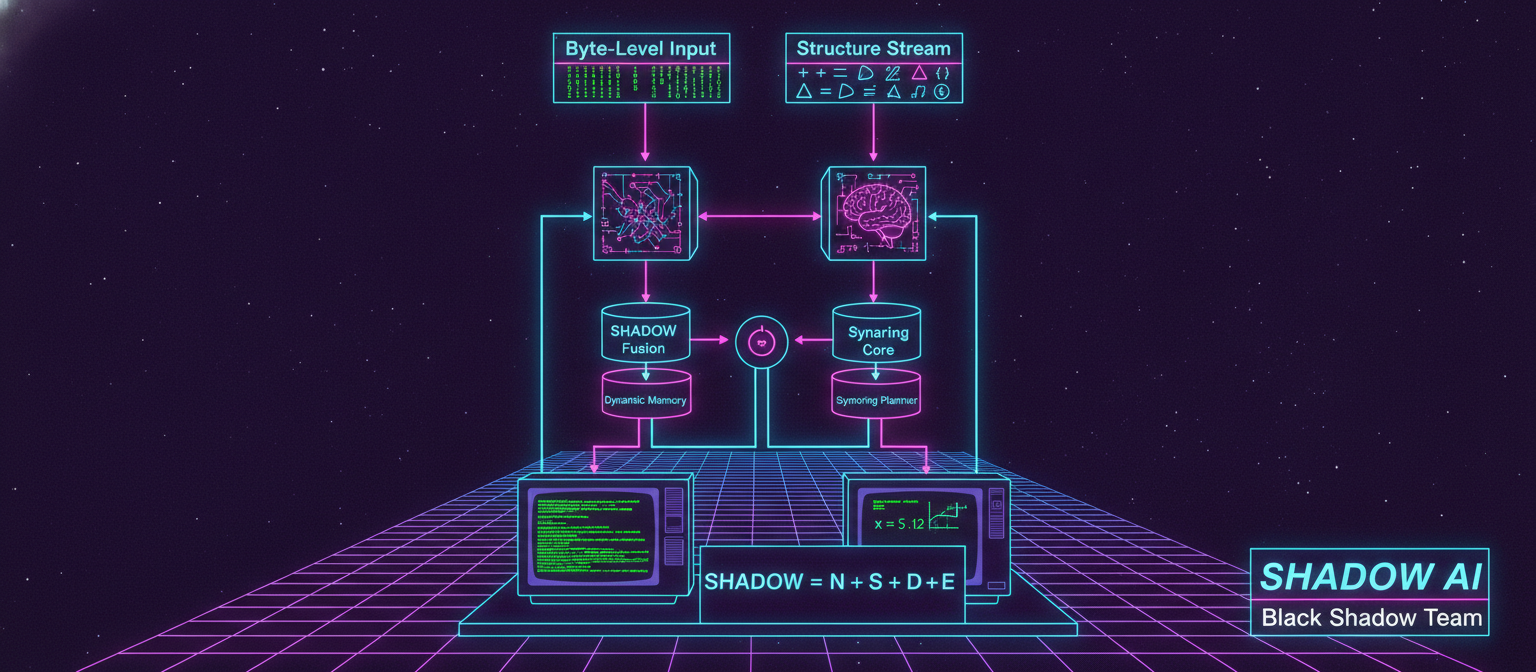
Project Type Experimental AI Model / Research Architecture / Foundational Language Model Model Family SHADOW AI Proposed Architecture SHADOW-HSR — Hybrid Symbolic Representation Architecture Core Objective SHADOW AI is a proposed experimental AI architecture designed to investigate whether useful multilingual language understanding, symbolic reasoning, contextual memory, and structured generation can be achieved with a more compact architecture than extremely large conventional language models. The architecture is designed around four primary components:
Neural Representation + Symbolic Reasoning + Dynamic State + Efficient Decoding SHADOW AI is intended to explore an alternative design philosophy rather than reproduce an existing commercial AI system. The project does not claim that training can be eliminated. A model capable of general language understanding still requires learning from data. Instead, the objective is to investigate whether architectural efficiency can reduce the amount of computation, vocabulary complexity, and external retrieval dependence required for useful intelligence.
- Executive Overview
Most modern language models rely heavily on large-scale neural sequence architectures trained on enormous datasets. SHADOW AI explores a different approach. Instead of treating every input purely as a sequence of language tokens, SHADOW separates information into several complementary representations:
SHADOW AI — Black Shadow Team | Page 2
Raw Input ■ ■■■ Byte Representation ■■■ Semantic Representation ■■■ Symbolic Representation ■■■ Structural Representation ■ ▼ SHADOW Fusion Layer ■ ▼ Context Processing ■ ▼ Dynamic Memory ■ ▼ Reasoning Core ■ ▼ Output Planning ■ ▼ Language Decoder This creates a hybrid system in which neural learning and deterministic or structured reasoning can cooperate.
- Core Design Philosophy
SHADOW AI follows seven principles.
2.1 Language Independence The model should not depend exclusively on a large language-specific vocabulary. A byte-level foundation allows the same basic input mechanism to process:
English
Bengali
Hindi
Arabic
Chinese
Japanese
code
numbers
mathematical expressions
symbols
mixed-language text
emojis
structured data
SHADOW AI — Black Shadow Team | Page 3
2.2 Symbol Awareness Symbols should not always be treated as ordinary text. For example: 5 + 7 may be interpreted structurally as: OPERATION ■■■ ADD ■■■ 5 ■■■ 7 This gives the reasoning system an explicit representation of the operation.
2.3 Internal Dynamic State SHADOW should maintain a compact runtime state representing relevant context. This is different from conventional external retrieval. The model should be able to maintain: Current Context + Working Memory + Reasoning State without requiring a retrieval database for every interaction.
2.4 Modular Reasoning The reasoning system should not necessarily be a single monolithic neural block. Possible reasoning components include: Semantic Reasoner Symbolic Reasoner Mathematical Reasoner Planning Layer Consistency Layer A controller determines which components are required.
SHADOW AI — Black Shadow Team | Page 4
2.5 Compact Architecture The first objective is not to build a trillion-parameter model. The first objective is to determine whether the architectural hypothesis works. Therefore development should begin with small models: SHADOW-Nano SHADOW-Mini SHADOW-Core SHADOW-1B The names represent possible model scales rather than predetermined specifications.
2.6 No Mandatory RAG RAG is not a core requirement of SHADOW AI. The core architecture should be capable of operating as: Input ↓ Neural Representation ↓ Dynamic State ↓ Reasoning ↓ Generation External retrieval can remain an optional future capability.
2.7 Verifiable Intelligence SHADOW should not be evaluated only by how impressive its demonstrations look. It should be evaluated through measurable benchmarks:
language modeling
multilingual understanding
symbolic reasoning
mathematics
code understanding
memory
SHADOW AI — Black Shadow Team | Page 5
latency
parameter count
memory consumption
training cost
inference cost
- SHADOW AI Mathematical Concept
A conceptual SHADOW state can be represented as: H_t = \operatorname{Fuse}(B_t,S_t,C_t,M_t) where:
B_t = byte representation
S_t = symbolic representation
C_t = current context
M_t = dynamic memory state
H_t = unified internal representation The reasoning stage can then be represented as: R_t = \operatorname{Reason}(H_t,A_t) where A_t represents the computation or attention allocation selected by the controller. The memory update becomes: M_{t+1} = \operatorname{Update}(M_t,R_t) Finally: Y_t = \operatorname{Decode}(R_t,M_{t+1}) where Y_t is the generated output. These equations describe the proposed architecture conceptually rather than claiming a proven optimal implementation.
- SHADOW-HSR Architecture
The proposed architecture contains seven major layers. ■■■■■■■■■■■■■■■■■■■■■■■■■■■■■■■■■■■■■■■■■■■ ■ SHADOW AI ■
SHADOW AI — Black Shadow Team | Page 6
■■■■■■■■■■■■■■■■■■■■■■■■■■■■■■■■■■■■■■■■■■■ ■ 7. Efficient Output Generator ■ ■■■■■■■■■■■■■■■■■■■■■■■■■■■■■■■■■■■■■■■■■■■ ■ 6. Reasoning Core ■ ■■■■■■■■■■■■■■■■■■■■■■■■■■■■■■■■■■■■■■■■■■■ ■ 5. Dynamic Memory State ■ ■■■■■■■■■■■■■■■■■■■■■■■■■■■■■■■■■■■■■■■■■■■ ■ 4. Context Mixer ■ ■■■■■■■■■■■■■■■■■■■■■■■■■■■■■■■■■■■■■■■■■■■ ■ 3. Symbolic & Structural Engine ■ ■■■■■■■■■■■■■■■■■■■■■■■■■■■■■■■■■■■■■■■■■■■ ■ 2. Universal Neural Encoder ■ ■■■■■■■■■■■■■■■■■■■■■■■■■■■■■■■■■■■■■■■■■■■ ■ 1. Byte-Level Input ■ ■■■■■■■■■■■■■■■■■■■■■■■■■■■■■■■■■■■■■■■■■■■
- Layer 1 — Byte-Level Input
SHADOW begins with UTF-8 byte sequences. A simplified tokenizer can therefore represent text using values from 0–255. Example: Hello becomes a UTF-8 byte sequence. Bengali text can be processed through the same mechanism. This avoids requiring a completely separate tokenizer vocabulary for every language. Advantages Byte-level processing can provide:
broad Unicode coverage
simple input representation
code compatibility
symbol compatibility
multilingual compatibility
reduced vocabulary engineering Limitation Byte-level modeling may increase sequence length. Therefore SHADOW's later architecture must investigate efficient sequence processing.
SHADOW AI — Black Shadow Team | Page 7
- Layer 2 — Universal Neural Encoder
The byte sequence is converted into vector representations. Conceptually: Bytes ↓ Embedding ↓ Local Pattern Encoder ↓ Semantic Representation A minimal implementation may begin with: x = byte_embedding(input) h = encoder(x) The encoder can initially use an established neural sequence architecture as a baseline. The long-term research objective is to investigate whether a more efficient sequence mechanism can replace or reduce conventional Transformer dependence.
- Layer 3 — Symbolic and Structural Engine This is one of SHADOW's defining components. The symbolic engine detects:
mathematical operators
comparison operators
brackets
structured expressions
numbers
identifiers
code syntax
JSON-like structures
logical relationships Example: 10 + 20 can become: ADD ■■■ 10 ■■■ 20
SHADOW AI — Black Shadow Team | Page 8
Another example: x + 5 = 12 can become: EQUATION ■■■ LEFT ■ ■■■ ADD(x, 5) ■■■ RIGHT ■■■ 12 This allows deterministic components to participate in reasoning.
- Symbolic Processing Pipeline
Input ■ ▼ Pattern Detection ■ ▼ Symbol Detection ■ ▼ Structural Parsing ■ ▼ Symbol Graph ■ ▼ Reasoning Interface A conceptual representation is: S = \operatorname{Parse}(X) + \operatorname{Structure}(X) + \operatorname{Relation}(X) The exact implementation can evolve during research.
- Layer 4 — Context Mixer The Context Mixer determines which information deserves computational priority. Example: User: "Show me the database design we discussed yesterday." Relevant concepts may include: database design previous discussion project context
SHADOW AI — Black Shadow Team | Page 9
The Context Mixer should prioritize useful information while reducing unnecessary computation. This could eventually support sparse or adaptive computation.
- Layer 5 — Dynamic Memory State
SHADOW introduces an internal working-memory mechanism. The initial implementation can be simple: Current Input ↓ Working Memory ↓ Compressed State ↓ Reasoning ↓ Updated State The conceptual update is: M_{t+1}=\operatorname{Update}(M_t,R_t) The first prototype can use a bounded memory buffer. Later versions can investigate learned memory compression.
- RAG vs SHADOW Internal State
Traditional RAG: Question ↓ Search ↓ Retrieve Documents ↓ Inject Context ↓ Model SHADOW's core operation: Input ↓ Representation ↓ Internal State ↓ Reasoning ↓ Output The purpose is not to prove that retrieval is unnecessary in all AI systems.
SHADOW AI — Black Shadow Team | Page 10
External retrieval remains useful for:
current information
large private knowledge bases
enterprise documents
continuously changing data SHADOW instead investigates whether general reasoning and learned knowledge can operate without making retrieval a mandatory architectural dependency.
- Layer 6 — Reasoning Core
The Reasoning Core coordinates different reasoning mechanisms. Possible architecture: Reasoning Controller ■ ■■■■■■■■■■■■■■■■■■■■■■■■■■■■■■■ ▼ ▼ ▼ Semantic Symbolic Planning Reasoner Reasoner Reasoner ■ ■ ■ ■■■■■■■■■■■■■■■■■■■■■■■■■■■■■■■ ▼ Unified Reasoning A simple mathematical problem could use the symbolic reasoner. A natural-language question could use the semantic reasoner. A multi-step task could use the planning component.
- Layer 7 — Efficient Output Generator
The final reasoning state is converted into natural-language output. Reasoning State ↓ Language Planner ↓ Sentence Construction ↓ Byte Decoder ↓ Output The same internal representation could theoretically produce different languages if multilingual training is successful.
SHADOW AI — Black Shadow Team | Page 11
- Multilingual Representation
A major research goal is to reduce language fragmentation. For example: It is raining. ■■■■■■ ■■■■■■ Está lloviendo. ■■■■ ■■■■. The model should ideally learn that these sentences represent closely related concepts. The architecture therefore attempts to create: Language A ↓ Universal Representation ↑ Language B ↑ Language C rather than completely isolated language systems. This must be demonstrated experimentally through multilingual benchmarks.
- Neural + Symbolic Fusion
The central SHADOW concept is: Neural Information ■ ▼ ■■■■■■■■■■■■■■■ ■ Fusion ■ ■■■■■■■■■■■■■■■ ▲ ■ Symbolic Information Neural components are useful for:
language
semantics
ambiguity
pattern recognition Symbolic components are useful for:
arithmetic
SHADOW AI — Black Shadow Team | Page 12
equations
structured logic
exact operations
deterministic transformations The combination may provide stronger reliability for structured tasks.
- Proposed Training Objective
The basic language objective can use next-token or next-byte prediction. \mathcal{L}{LM} = -\sum_t \log P(x_t|x{<t}) SHADOW can eventually investigate multiple objectives: \mathcal{L}{SHADOW} = \lambda_1\mathcal{L}{text} + \lambda_2\mathcal{L}{symbol} + \lambda_3\mathcal{L}{reason} + \lambda_4\mathcal{L}_{consistency} Where:
\mathcal{L}_{text} = language objective
\mathcal{L}_{symbol} = symbolic objective
\mathcal{L}_{reason} = reasoning objective
\mathcal{L}_{consistency} = representation consistency objective The weighting values must be determined experimentally.
- Training Data Architecture
The training corpus can contain several categories. SHADOW DATASET ■ ■■■ General Language ■ ■■■ English ■ ■■■ Bengali ■ ■■■ Hindi ■ ■■■ Arabic ■ ■■■ Other Languages ■ ■■■ Mathematics ■ ■■■ Arithmetic ■ ■■■ Algebra ■ ■■■ Geometry ■ ■■■ Equations ■ ■■■ Code ■ ■■■ Python ■ ■■■ JavaScript ■ ■■■ TypeScript ■ ■■■ SQL ■
SHADOW AI — Black Shadow Team | Page 13
■■■ Structured Data ■ ■■■ JSON ■ ■■■ Tables ■ ■■■ Schemas ■ ■■■ Reasoning Data ■■■ Logic ■■■ Planning ■■■ Classification ■■■ Problem Solving Dataset provenance, licensing, privacy, quality, and duplication must be controlled.
- SHADOW Project Structure
The first prototype can use: shadow-ai/ ■ ■■■ README.md ■■■ LICENSE ■■■ requirements.txt ■■■ config.py ■■■ train.py ■■■ evaluate.py ■■■ generate.py ■ ■■■ shadow/ ■ ■■■ init.py ■ ■■■ tokenizer.py ■ ■■■ embeddings.py ■ ■■■ encoder.py ■ ■■■ symbols.py ■ ■■■ context.py ■ ■■■ memory.py ■ ■■■ reasoning.py ■ ■■■ decoder.py ■ ■■■ model.py ■ ■■■ data/ ■ ■■■ train.txt ■ ■■■ validation.txt ■ ■■■ checkpoints/ ■ ■■■ tests/ ■■■ test_tokenizer.py ■■■ test_symbols.py ■■■ test_memory.py ■■■ test_model.py
- Technology Stack
The initial research implementation can remain intentionally small. Language: Python Deep Learning: PyTorch Numerical Computing:
SHADOW AI — Black Shadow Team | Page 14
NumPy Training Utilities: tqdm Checkpoint Format: PyTorch / SafeTensors The first prototype does not require:
a web application
a database
RAG infrastructure
Kubernetes
microservices
a complex API The goal is to prove the model architecture first.
- Minimal Byte Tokenizer
class ShadowTokenizer: def encode(self, text: str): return list(text.encode("utf-8")) def decode(self, tokens): return bytes(tokens).decode( "utf-8", errors="replace" ) This provides a very small foundational input interface.
- Symbol Detection
SYMBOLS = { "+": "ADD", "-": "SUBTRACT", "*": "MULTIPLY", "/": "DIVIDE", "=": "EQUAL", ">": "GREATER", "<": "LESS", } def detect_symbols(text): result = [] for char in text: if char in SYMBOLS: result.append({ "symbol": char, "type": SYMBOLS[char] })
SHADOW AI — Black Shadow Team | Page 15
return result This is a deterministic component rather than a learned model.
- Safe Symbolic Calculator
A prototype should avoid unrestricted eval(). A controlled implementation can parse a restricted expression tree: import ast import operator OPS = { ast.Add: operator.add, ast.Sub: operator.sub, ast.Mult: operator.mul, ast.Div: operator.truediv, } def calculate(expression): tree = ast.parse( expression, mode="eval" ) def evaluate(node): if isinstance(node, ast.Constant): return node.value if isinstance(node, ast.BinOp): operation = OPS[type(node.op)] return operation( evaluate(node.left), evaluate(node.right) ) raise ValueError( "Unsupported expression" ) return evaluate(tree.body) The allowed syntax should remain deliberately restricted.
- Initial Working Memory
class ShadowMemory: def init(self, max_items=32): self.items = [] self.max_items = max_items def add(self, value):
SHADOW AI — Black Shadow Team | Page 16
self.items.append(value) if len(self.items) > self.max_items: self.items.pop(0) def get(self): return self.items This is only the first prototype. A future SHADOW version should investigate learned state compression.
- Baseline Neural Model
The first model should establish a measurable baseline. import torch import torch.nn as nn class ShadowModel(nn.Module): def init( self, vocab_size=256, hidden_size=256, layers=6 ): super().init() self.embedding = nn.Embedding( vocab_size, hidden_size ) encoder_layer = ( nn.TransformerEncoderLayer( d_model=hidden_size, nhead=8, batch_first=True ) ) self.encoder = nn.TransformerEncoder( encoder_layer, num_layers=layers ) self.output = nn.Linear( hidden_size, vocab_size ) def forward(self, tokens): x = self.embedding(tokens) x = self.encoder(x) return self.output(x) Important Research Note This Transformer-based implementation should be considered a baseline, not the final SHADOW architecture.
SHADOW AI — Black Shadow Team | Page 17
The purpose is to obtain a working model against which future architecture changes can be measured.
- Training Pipeline
Dataset ↓ Cleaning ↓ Unicode / Byte Encoding ↓ Sequence Construction ↓ Batching ↓ Forward Pass ↓ Loss ↓ Backpropagation ↓ Optimizer ↓ Checkpoint ↓ Evaluation
- Basic Training Skeleton
import torch from torch.utils.data import Dataset, DataLoader from shadow.model import ShadowModel class TextDataset(Dataset): def init(self, text, seq_len=128): self.data = torch.tensor( list(text.encode("utf-8")), dtype=torch.long ) self.seq_len = seq_len def len(self): return max( 0, len(self.data)
self.seq_len
1 ) def getitem(self, index): x = self.data[ index:index + self.seq_len ] y = self.data[ index + 1: index + self.seq_len + 1 ]
SHADOW AI — Black Shadow Team | Page 18
return x, y model = ShadowModel() optimizer = torch.optim.AdamW( model.parameters(), lr=3e-4 ) loss_fn = torch.nn.CrossEntropyLoss() with open( "data/train.txt", "r", encoding="utf-8" ) as file: text = file.read() dataset = TextDataset(text) loader = DataLoader( dataset, batch_size=8, shuffle=True ) for epoch in range(5): for x, y in loader: logits = model(x) loss = loss_fn( logits.reshape(-1, 256), y.reshape(-1) ) optimizer.zero_grad() loss.backward() optimizer.step() print( f"epoch={epoch} " f"loss={loss.item():.4f}" ) torch.save( model.state_dict(), "checkpoints/shadow.pt" ) This is a minimal research prototype, not a production training system.
- Generation
import torch from shadow.model import ShadowModel from shadow.tokenizer import ShadowTokenizer model = ShadowModel()
SHADOW AI — Black Shadow Team | Page 19
model.load_state_dict( torch.load( "checkpoints/shadow.pt", map_location="cpu" ) ) model.eval() tokenizer = ShadowTokenizer() def generate(prompt, length=100): tokens = tokenizer.encode(prompt) x = torch.tensor( [tokens], dtype=torch.long ) with torch.no_grad(): for _ in range(length): logits = model(x) next_token = torch.argmax( logits[:, -1, :], dim=-1 ) x = torch.cat( [ x, next_token[:, None] ], dim=1 ) return tokenizer.decode( x[0].tolist() ) print( generate("Hello") )
- Why the First Model Will Be Weak
A small prototype will not immediately demonstrate advanced intelligence. Expected early limitations include:
repetitive generation
weak grammar
poor multilingual performance
limited context
weak reasoning
hallucination
poor code understanding
SHADOW AI — Black Shadow Team | Page 20
- insufficient training data This is normal. The development loop should therefore be: Prototype ↓ Benchmark ↓ Identify Failure ↓ Modify Architecture ↓ Retrain ↓ Benchmark Again
- SHADOW Model Development Roadmap
SHADOW 0.1 — Baseline Byte Input + Embedding + Baseline Sequence Model + Decoder
SHADOW 0.2 — Symbolic Integration Add: Symbol Detection + Structured Parsing + Deterministic Operations
SHADOW 0.3 — Dynamic Memory Add: Working Memory + Context Compression + State Update
SHADOW AI — Black Shadow Team | Page 21
SHADOW 0.4 — Multilingual Learning Train on: English Bengali Hindi Arabic Additional languages
SHADOW 0.5 — Reasoning Controller Add: Semantic Reasoner Symbolic Reasoner Planning Component
SHADOW 0.6 — Efficient Sequence Core Research alternatives to the initial Transformer baseline. Potential directions include: State-space sequence processing Recurrent architectures Sparse computation Linear-attention approaches Hybrid sequence mechanisms No single alternative should be assumed superior without measurement.
SHADOW 0.7 — Code and Mathematics Expand training and evaluation for:
programming
algorithms
mathematics
structured data
formal expressions
SHADOW AI — Black Shadow Team | Page 22
SHADOW 0.8 — Compression Investigate:
quantization
pruning
distillation
weight sharing
efficient inference
SHADOW 0.9 — Runtime Optimization Optimize:
latency
memory
batching
CPU inference
GPU inference
model loading
context processing
SHADOW 1.0 — Research Release The 1.0 release should only happen after measurable evaluation. It should include: Model + Tokenizer + Symbol Engine + Memory + Reasoning + Evaluation Suite + Documentation
SHADOW AI — Black Shadow Team | Page 23 30. Model Size Strategy
Do not start with a huge model. A practical research sequence is: SHADOW-Nano ↓ SHADOW-Mini ↓ SHADOW-Core ↓ SHADOW-Large The exact parameter counts should be selected based on available hardware and benchmark results. The goal is to determine:
How much capability can SHADOW obtain per parameter and per unit of computation?
- Evaluation Framework
SHADOW should be evaluated using controlled experiments. Language Measure:
perplexity
grammar
instruction following
semantic understanding Multilingual Measure:
Bengali understanding
English understanding
translation
mixed-language handling Symbolic Measure:
SHADOW AI — Black Shadow Team | Page 24
arithmetic
equations
comparisons
structured transformations Reasoning Measure:
logical reasoning
multi-step problems
planning
consistency Code Measure:
syntax understanding
code completion
debugging
code explanation
- Efficiency Metrics
Every SHADOW experiment should record: Parameter Count Training Tokens Training Time GPU Hours Peak VRAM Checkpoint Size Inference Latency Tokens/Second CPU Memory GPU Memory Then calculate efficiency. For example: Efficiency = \frac{Task\ Performance} {Compute\ Cost} This is more meaningful than simply comparing raw benchmark scores.
SHADOW AI — Black Shadow Team | Page 25 33. Baseline Comparison SHADOW should initially compare against models with approximately similar parameter counts. For example: SHADOW-50M vs Baseline-50M and: SHADOW-100M vs Baseline-100M Measure: Accuracy Perplexity Reasoning Memory Latency Training Cost The project should not claim that SHADOW is superior to major commercial models without controlled evidence.
- Core Research Hypothesis
The central research hypothesis is:
A compact neural architecture augmented with symbolic processing, dynamic internal state, and efficient sequence computation may provide useful multilingual and structured reasoning capabilities with lower computational requirements than an equivalently trained conventional baseline. This hypothesis is experimentally testable. It is not an established scientific conclusion.
- What Makes SHADOW Different?
The proposed research direction combines: Byte-Level Representation + Symbolic Representation + Neural Semantics + Dynamic Internal State + Adaptive Reasoning
SHADOW AI — Black Shadow Team | Page 26
Efficient Decoding The intended distinction is architectural integration rather than simply adding another language model wrapper.
- SHADOW Core Formula
The conceptual identity of the architecture is: \boxed{ \text{SHADOW Intelligence} = \text{Neural Representation} + \text{Symbolic Reasoning} + \text{Dynamic State} + \text{Efficient Decoding} } This should be treated as the project's foundational design principle.
- Complete End-to-End Architecture
SHADOW AI ■ ▼ ■■■■■■■■■■■■■■■■■ ■ Universal Input■ ■■■■■■■■■■■■■■■■■ ■ ▼ ■■■■■■■■■■■■■■■■■ ■ Byte Encoder ■ ■■■■■■■■■■■■■■■■■ ■ ■■■■■■■■■■■■■■■■■■■■■■■■■■■■■■■ ■ ■ ■ ▼ ▼ ▼ Text Stream Symbol Stream Structure Stream ■ ■ ■ ■■■■■■■■■■■■■■■■■■■■■■■■■■■■■■■ ■ ▼ ■■■■■■■■■■■■■■■■■ ■ Shadow Fusion ■ ■■■■■■■■■■■■■■■■■ ■ ▼ ■■■■■■■■■■■■■■■■■ ■ Context Mixer ■ ■■■■■■■■■■■■■■■■■ ■ ▼ ■■■■■■■■■■■■■■■■■ ■ Dynamic Memory■ ■■■■■■■■■■■■■■■■■ ■ ▼ ■■■■■■■■■■■■■■■■■ ■Reasoning Core ■ ■■■■■■■■■■■■■■■■■ ■ ■■■■■■■■■■■■■■■■■■■■■■■ ▼ ▼ ▼ Semantic Symbolic Planning Reasoner Reasoner Reasoner ■■■■■■■■■■■■■■■■■■■■■■■ ■ ▼
SHADOW AI — Black Shadow Team | Page 27
■■■■■■■■■■■■■■■■■ ■ Output Planner■ ■■■■■■■■■■■■■■■■■ ■ ▼ ■■■■■■■■■■■■■■■■■ ■ Byte Decoder ■ ■■■■■■■■■■■■■■■■■ ■ ▼ OUTPUT
- Recommended First Implementation
The first actual build should intentionally contain only: Python PyTorch Byte Encoder Small Neural Model Symbol Detector Simple Memory Training Loop Generation Script Evaluation Script Do not initially build: Web Application Database RAG Kubernetes Microservices Payment System Cloud Infrastructure Those belong after the core model works.
- Complete Build Sequence
STEP 01 Create Project ↓ STEP 02 Install Python + PyTorch ↓ STEP 03 Implement Byte Encoder ↓ STEP 04 Implement Baseline Model ↓ STEP 05 Create Small Dataset
SHADOW AI — Black Shadow Team | Page 28
↓ STEP 06 Train SHADOW-0.1 ↓ STEP 07 Generate First Output ↓ STEP 08 Implement Symbol Engine ↓ STEP 09 Implement Working Memory ↓ STEP 10 Integrate Reasoning ↓ STEP 11 Add Multilingual Data ↓ STEP 12 Create Evaluation Suite ↓ STEP 13 Optimize Architecture ↓ STEP 14 Scale Model ↓ STEP 15 Compress Model ↓ STEP 16 Deploy Research Model
- Final Vision
The long-term SHADOW AI architecture is not intended to be merely another chatbot. The research goal is to create a compact AI system capable of processing: Natural Language + Multiple Languages + Symbols + Numbers
SHADOW AI — Black Shadow Team | Page 29
Code + Structured Information + Context + Internal State + Reasoning through a unified architecture. The final conceptual system is: SHADOW AI ■ ■■■■■■■■■■■■■■■■■■■■■■■■■■■■■ ■ ■ ■ Neural Symbolic Structured Learning Reasoning Processing ■ ■ ■ ■■■■■■■■■■■■■■■■■■■■■■■■■■■■■ ■ Dynamic State ■ Reasoning ■ Generation ■ Output The project should remain evidence-driven. SHADOW should not claim to outperform established models until experiments demonstrate it. The correct development philosophy is:
Design → Implement → Train → Measure → Compare → Improve → Repeat. The ultimate objective is not simply to make a smaller model. It is to investigate whether better architectural coordination between neural learning, symbolic reasoning, internal state, multilingual representation, and efficient computation can produce a more efficient form of useful AI.
SHADOW AI
Proposed Identity Name: SHADOW AI Architecture: SHADOW-HSR Research Direction: Hybrid Neural-Symbolic AI Primary Goal: Compact multilingual reasoning Core Input: UTF-8 byte representation Core Intelligence: Neural + Symbolic + Dynamic State
SHADOW AI — Black Shadow Team | Page 30
Mandatory RAG: No Primary Framework: PyTorch Initial Language: Python Initial Target: Small research prototype Long-Term Target: Efficient general-purpose AI model Foundational Formula \boxed{ \text{SHADOW} = N + S + D + E } Where:
N = Neural Representation
S = Symbolic Reasoning
D = Dynamic State
E = Efficient Computation
Final Statement SHADOW AI is a proposed research architecture, not a claim that a complete AGI-class model can be produced with a few hundred lines of code or without training. The practical innovation target is architectural efficiency: building a measurable, modular AI system in which language, symbols, structure, memory, and reasoning cooperate rather than forcing every problem through one undifferentiated representation. The first milestone is therefore not “build the world's smartest AI.” The first milestone is:
Build a small SHADOW model that works, measure it honestly, and then prove whether each architectural idea actually improves capability or efficiency.